

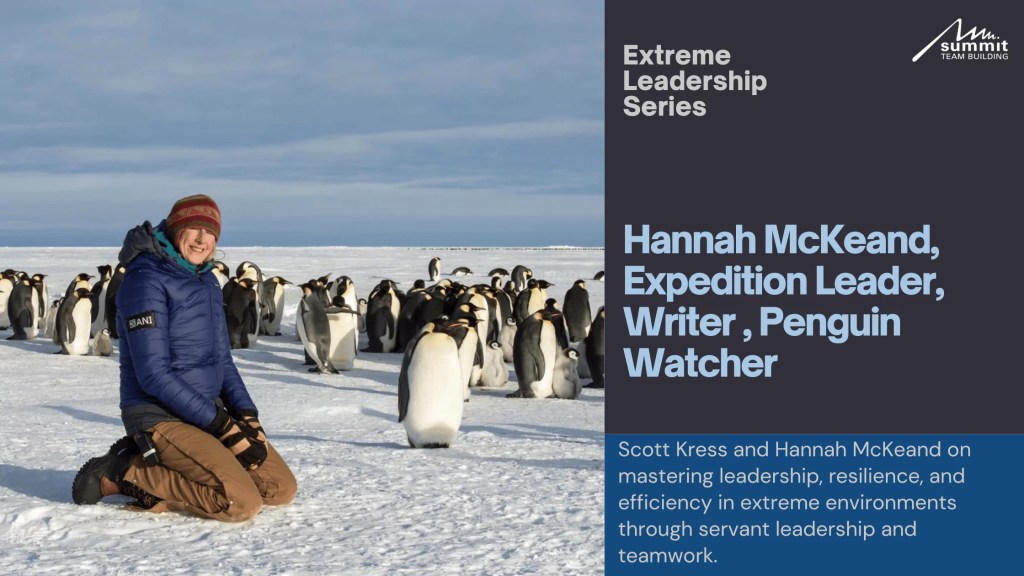
Mastering Polar Leadership: Insights from Hannah McKeand’s Extreme Expeditions
Introduction
In this episode of the Extreme Leadership Podcast, host Scott Kress interviews Hannah McKeand, one of the most experienced polar adventurers and guides in the world. With over 6,000 miles skied across Antarctica and a Guinness World Record for the fastest solo ski to the South Pole (which she once held), Hannah shares her incredible journey. A polar expedition guide, award-winning travel writer, and board member of the International Polar Guides Association, she offers profound insights into leadership, resilience, and teamwork in the most extreme environments.
Watch the Interview
Timeline with Timestamps
00:01 – 06:56 | Introduction to Guinness World Record Holder Hannah McKeand
Scott opens the podcast by introducing guest Hannah McKeand, an experienced adventurer who held a Guinness World Record for the fastest ski to the South Pole. She has led six expeditions in Antarctica, totaling over 6,000 miles. Hannah is also a fellow of the Royal Geographic Society, an award-winning travel writer, and a board member of the International Polar Guide Association.
Hannah shares her unconventional journey from a career in theater management to polar expeditions. Initially a client on a guided trip to the South Pole, she later returned solo and unsupported, briefly holding the speed record to the South Pole. Although her record has since been surpassed, Hannah reflects positively on her accomplishment.
After her solo expedition, she began guiding others and applied project management skills from her theater career to her new role. Hannah’s guiding was successful, leading multiple expeditions to the South Pole. Later, she transitioned into managerial roles, including managing a remote camp for Emperor Penguin experiences and serving as the area manager for the South Pole Station, overseeing 150 people in extreme conditions.
07:37 – 17:56 | Mastering Polar Expeditions: Record, Challenge, and Training
Scott and Hannah discuss her world record for completing six full coast-to-pole expeditions. Despite others attempting to surpass her, she still holds this record. Scott asks what drives Hannah to repeatedly undertake such grueling expeditions, to which she humorously responds that it was for the money but admits to genuinely enjoying the environment, finding it calming and meditative. The repetitive, organized nature of the expedition soothes her, though she acknowledges the tough conditions.
Hannah reveals that her favorite region is the Arctic Ocean, which she finds incredibly stimulating due to its constant problem-solving challenges. Unlike the South Pole, where repetition prevails, the Arctic demands constant adaptability due to shifting ice and unpredictable conditions. She enjoys the mental engagement of navigating the ice and planning each move.
Hannah also discusses founding Polar Expedition Training (PET) to better prepare individuals for extreme environments. She explains how, during her guiding years, many clients arrived unprepared, making the first few weeks of expeditions unnecessarily difficult. PET focuses on giving individuals the skills to enjoy their experience from day one, offering rigorous two-week boot camps in Norway. These programs aim to equip people with the knowledge to be independent explorers, even if they never take on a major expedition.
17:58 – 24:58 | How a Blizzard Changed the Leadership Dynamics
Scott shifts the discussion toward leadership, asking Hannah what makes a great leader in extreme environments. Hannah explains that leadership style depends on the number of people being managed. In smaller expedition groups, the environment plays a significant role in influencing behavior. She recalls an early expedition with a group of alpha male businessmen, where her authority was initially ignored. However, a sudden blizzard forced them to rely on her expertise, which helped her assert her leadership more effectively.
Hannah notes that this was not leadership, but luck. Over time, she refined her leadership style, focusing on ensuring her clients had an enjoyable and successful experience. She emphasizes a customer-service-oriented approach to leadership, where her role is to help clients achieve their goals while learning to navigate the challenges of polar expeditions independently. Her goal is to ensure that, when clients later brag about their achievements, they have genuinely earned the experience through self-sufficiency.
In larger management settings, like running the South Pole Station, Hannah highlights the importance of a two-way relationship. Leaders should listen to their teams, understanding the barriers to success, and work collaboratively to achieve goals. She believes that leadership is about supporting others in their success, as it ultimately reflects on the leader’s success as well.
26:45 – 31:55 | Putting Your Leadership Ego in Check
Scott observes that Hannah’s leadership style emphasizes teaching and helping others achieve their goals, aligning with the principles of servant leadership. He asks if this is something she was born with or learned over time. Hannah reflects that while leadership qualities can be taught, personal work, particularly around ego, is essential. She believes that ego is often at the root of interpersonal and leadership problems. Over time, through age, experience, and self-analysis, she has learned to question her ego-driven reactions, which has helped her grow as a leader.
Scott adds that emotional intelligence matures with age, and most people learn to manage their ego better. He then asks if Hannah has drawn inspiration from polar history leaders. Hannah acknowledges Ernest Shackleton’s greatness but expresses frustration with his over-glorification. Instead, she highlights Will Steger, who led the Trans-Antarctic Expedition during the Cold War, bringing together a multinational team from countries like China, Russia, the UK, and the US. Steger’s leadership in navigating the challenges of this eight-month crossing of Antarctica stands out to Hannah as one of the greatest polar expeditions ever.
33:31 – 37:56 | Efficiency is Vital in Extreme Conditions
Scott asks Hannah how she defines a high-performance team in a polar environment. Hannah explains that efficiency is the key to success in extreme conditions. This includes efficiency in systems, nutrition, travel routines, and time management. In such environments, any loss of efficiency negatively impacts the expedition, so everything they teach revolves around streamlining processes to conserve energy, time, and resources.
Hannah gives an example of navigation during a whiteout, where the leader must stay focused on the compass to avoid drifting off course. Even small deviations can result in significant inefficiencies over time. She shares a story about a client who refused to follow her advice about staying on course, thinking the tiny deviations didn’t matter. To demonstrate the impact, they each navigated for half an hour, and the client ended up nearly a mile off course, showcasing how small mistakes can accumulate into major inefficiencies. Hannah stresses that paying attention to detail and maintaining efficiency are crucial to high performance in polar travel.
38:31 – 42:42 | Communicating During a Whiteout
Scott asks Hannah how she maintains effective communication in polar environments where talking is difficult, such as when traveling in a line with wind blowing. Hannah emphasizes that it’s a daily challenge she works on during her courses. As an experienced guide, she knows the common issues that arise, like frustration during whiteout navigation or team members not feeling confident enough to stop the group for small but important issues like blisters.
To address this, Hannah stresses the importance of being observant, constantly paying attention to team members for signs of unspoken problems. She prepares teams by discussing communication challenges beforehand, especially during tough conditions like whiteouts. For example, to reduce frustration, she suggests designating one person, typically the third in line, to be the only one who communicates navigation corrections, such as saying “drifting left” or “drifting right.” This formal approach creates a supportive environment and prevents multiple voices from overwhelming the leader. She notes that each team will find its own solutions, but the key is to foster a system that is collaborative rather than critical or antagonistic.
43:15 – 47:47 | The Importance of a Calm, Secure Team & a Beard
Scott asks Hannah to recall a time when teamwork was crucial in an extreme environment, like a storm. Hannah explains that in every storm, teamwork is what prevents bad outcomes, although she hasn’t experienced major dramas due to having well-prepared teams. She emphasizes the importance of having systems in place, including non-verbal communication like sign language, to keep the team aligned in difficult conditions where verbal communication is nearly impossible.
Hannah mentions that nothing is ever entirely new on polar expeditions, and challenges like extreme cold or soft snow repeat themselves over time. A calm, secure team is key to navigating these situations, and part of feeling safe in extreme environments is having the right gear. When advising others on clothing for polar expeditions, she emphasizes that there is no “best jacket”—it depends on personal needs, such as how a person’s body reacts to cold. For example, women may need more face protection due to the lack of beards, and individuals with more body fat may need longer jackets for warmth. Ultimately, she advises that feeling safe in one’s clothing, equipment, and environment is the most important factor in extreme expeditions.
Timestamp: 00:48:01 – 00:51:48 | Being the “Benign Dictator” & Encountering a Bear
Scott discusses the role of a leader in navigating change and how polar expeditions, especially in the Arctic, often require leaders to adjust plans quickly due to environmental shifts and how a leader should absorb and communicate these changes to the team. Hannah explains that in polar expeditions, a leader must be a “benign dictator,” where there can only be one clear decision-maker who has exceptional experience in the environment. In rare instances, like encountering a bear, quick, unquestioning responses from the team are necessary, but these situations are infrequent.
The key to successful leadership, according to Hannah, is building a relationship where the team willingly responds to commands when necessary. This requires respectful listening and avoiding triggering defensive responses in people. When communication causes defensiveness, it becomes unproductive, and the leader must rethink their approach. Hannah highlights that this principle applies to personal relationships as well, where constructive conversations should replace reactive or confrontational ones. She emphasizes that effective communication is about ensuring that people truly hear and understand you, whether in polar expeditions or everyday relationships.
52:29 – 59:20 | Can Resilience be Taught and What’s it Look Like?
Scott discusses the need for leaders to adapt their style depending on the situation, from being commanding to being a facilitator, and asks Hannah about the importance of resilience on long, mentally and physically exhausting polar expeditions. He wonders whether resilience can be taught or if it is something people must inherently possess.
Hannah responds by acknowledging that while people who pursue these expeditions usually have some level of resilience, each person has strengths and weaknesses within that resilience. She shares a story about her last one-on-one guided trip with a Finnish client. They had an agreement where Hannah would handle tasks like cooking and melting snow while the client took time to journal and relax. However, Hannah had her own need for a quiet moment each morning, which her client eventually understood and respected. This mutual understanding helped them balance each other’s needs and strengths.
Hannah emphasizes that part of teamwork is recognizing where each person’s resilience lies and stepping in when needed. She shares how, during expeditions, she would take on extra physical weight from teammates who were struggling because she was particularly strong at pulling sleds. She teaches her teams that everyone brings value, whether it’s physical strength, humor, or kindness. Resilience, she notes, doesn’t always look like physical toughness; it can manifest in many ways, and it’s important to acknowledge and leverage each person’s unique contribution.
Timestamp: 00:59:32 – 01:04:47 | Solo vs. Team Expeditions & the Toilet Test
Scott asks Hannah about the differences between solo and team expeditions, and what she finds most rewarding and challenging about solo expeditions. Hannah reflects on her own solo experience, describing it as one of the most rewarding and peaceful periods of her life. Unlike some solo travelers who struggle and write about their hardships, Hannah found her solo journey to be a giant meditation. Without the need to worry about anyone else’s issues or weaknesses, she was able to fully immerse herself in the environment, moving efficiently and without stress.
She contrasts her approach with others who seem to “battle” the environment, especially military types who see expeditions as a test of endurance against harsh conditions. For Hannah, it’s more about accepting the environment and moving through it quietly and without disturbance. One of her key tips for soloists is to “just keep moving” every day, regardless of the conditions. She shares her “toilet test” advice, which encourages soloists to step out of their tent and assess the conditions before deciding not to travel for the day. Often, conditions seem worse from inside the tent, but getting outside reveals that it’s manageable. Hannah finds great joy in solo travel and would love to do it again, albeit quietly and without fanfare.
Scott humorously points out that the toilet test might not work for soloists who use their tent vestibule as a toilet, to which Hannah responds that she never did that.
01:04:49 – 01:08:14 | Recalling Hannah’s Favorite Team Experience: The Blizzard Expedition
Scott asks Hannah to recall a favorite team experience. Hannah fondly remembers a trip aboard a 60-foot aluminum schooner named Blizzard, which she and her partner, Australian yachtsman Dave Price, refitted as a high-latitude expedition yacht. In 2005-2008, they sailed from Hobart, Tasmania, to the west coast of Chile with a crew of eight. The 31-day passage took them through the challenging Southern Ocean, notorious for its brutal conditions, including storms, ice, and boat-destroying weather.
Despite the dangers and harsh environment, Hannah recalls the trip as one filled with laughter, excitement, and camaraderie. The crew, composed of bright-eyed, enthusiastic young individuals, created a fantastic team dynamic. They encountered immense storms and extreme conditions but managed to operate safely and effectively in the vast, savage ocean. The experience left a lasting impression on Hannah, and although the Blizzard Expeditions company no longer exists, she cherishes the memories of that extraordinary voyage, which can still be glimpsed in a short video on YouTube.
01:09:18 – 01:12:51 | Finding Joy in Helping Others Succeed
Scott wraps up the conversation by emphasizing the importance of leadership, teamwork, and preparation, which allow people to go through challenging experiences and find joy in the process. He notes that Hannah’s work is filled with joy because everything is well-organized, and the focus is not on survival, but on enjoying the experience.
Hannah adds that joy doesn’t need to come from big achievements or external recognition. As a leader, she finds joy in helping others succeed, comparing it to the pride a parent feels watching their child. She offers advice to aspiring guides: “lead from the back,” both metaphorically and physically. Leading from the back allows the leader to see the team and anticipate problems while giving the team the glory. She notes that guides shouldn’t expect or seek personal glory, but should focus on helping the team thrive.
Scott concludes by reinforcing the idea of servant leadership, where the leader’s role is to serve the team. He thanks Hannah for sharing her stories and insights and hopes the conversation inspires listeners to reflect on their leadership style and push their boundaries. Hannah expresses her pleasure in the discussion and looks forward to chatting again.
Interested in Creating Your Own Extreme Leadership Team?
Scott offers a series of Keynote presentations and workshops on team building. Here’s a quick video of Scott in action! Contact us to explore this further.
About The Extreme Leadership Series
The Extreme Leadership Series is a dynamic exploration of leadership through the lens of extraordinary situations. Hosted by Scott Kress, it features a mix of engaging podcasts and insightful written interviews with leaders who have thrived in some of the world’s most demanding environments. From the icy wilderness of polar regions to the towering summits of the highest mountains, guests share their stories of resilience, teamwork, and courage.
This series goes beyond mere adventure tales; it delves into the core principles of effective leadership such as preparation, adaptability, and the ability to cultivate high-performance teams. It offers valuable lessons for leaders in any field, aiming to educate, inspire, and equip listeners and readers with the tools to lead under pressure.
Whether you’re an emerging leader seeking motivation, an experienced executive aiming to enhance your skills, or simply intrigued by the intersection of leadership and extreme challenges, the Extreme Leadership Series provides a unique perspective on navigating adversity and achieving success. Join Scott Kress on this journey to uncover what it takes to lead in the most unforgiving circumstances, where every decision can make a difference.